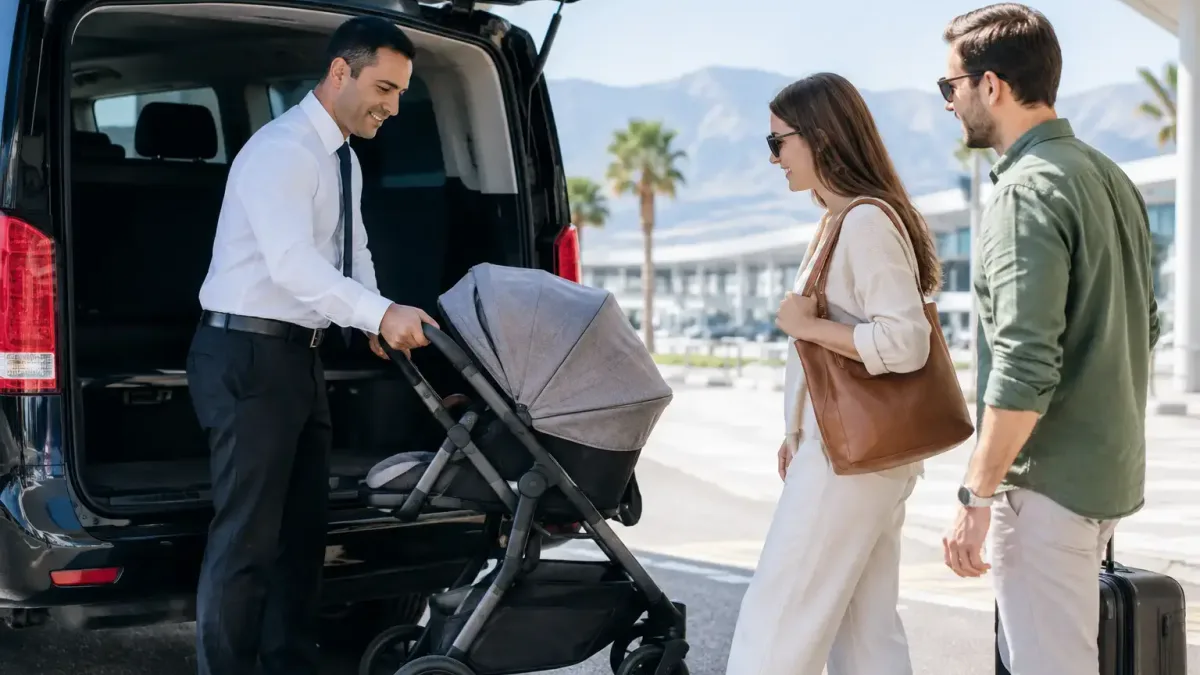
A pushchair can be the difference between a relaxed family arrival and a difficult walk through an unfamiliar resort with a tired toddler. So, can drivers carry pushchairs on Antalya transfers? In most cases, yes - provided the pushchair is included in your booking details and the vehicle is selected with your party, luggage and equipment in mind.
For a private airport transfer, the key issue is not whether a driver will accept a buggy. It is whether there is enough safe, protected boot space once suitcases, hand luggage and any child seats are loaded. A clear reservation avoids last-minute compromises at Antalya Airport and lets your driver arrive with the right vehicle for your family.
Can drivers carry pushchairs with airport luggage?
A folding pushchair will usually fit comfortably in a spacious Mercedes Vito or Sprinter, particularly when the number of passengers and cases has been declared accurately. These vehicles are designed for private holiday transfers and give families far more practical room than an ordinary saloon taxi.
However, capacity depends on the whole load. A compact umbrella pushchair for two adults and one child is very different from a large travel-system pushchair, two full-size suitcases, a cot and several cabin bags. The more equipment you bring, the more important it becomes to state it in advance.
For this reason, never assume that a vehicle advertised by passenger number alone will have unlimited luggage room. A seven-seat vehicle may be ideal for a larger family travelling light, while a smaller party with bulky pushchairs and resort luggage may benefit from a larger van. Private transport should feel comfortable from the first kilometre, not crowded before you leave the airport.
What to tell your transfer provider before you travel
When booking, mention that you are carrying a pushchair and say whether it folds. If possible, provide its approximate folded dimensions or describe it as compact, standard or large travel-system size. This gives the operations team a useful picture of the boot space required.
You should also confirm the number of passengers, children, large suitcases and cabin bags. Include other bulky items such as car seats, travel cots, golf bags or mobility equipment. These details are not formalities. They allow the vehicle to be allocated correctly and help keep the collection smooth when everyone is tired after a flight.
If your pushchair has detachable parts, such as a carrycot, seat unit or removable wheels, say so. It may still travel easily, but those components use additional space. Keep loose accessories together in a bag where possible, rather than expecting them to be carried separately in the passenger area.
At Antalya Transfer Club, every reservation is for a private vehicle only for your booking. That means your pushchair does not need to compete for space with another family's luggage, as it can on a shared shuttle. It also means the vehicle can be matched to your own group and requirements before arrival.
Folding the pushchair for transport
Drivers generally need the pushchair folded and ready to place in the luggage area. Folding it before meeting your driver saves time at the airport kerbside and keeps the pickup area clear, especially during busy summer arrivals.
Remove valuables, snacks, bottles and personal items first. The vehicle may travel over normal road surfaces, bends and resort access roads, so an unsecured item can fall out or be damaged. Use the manufacturer’s travel lock if your model has one, and keep any rain cover or footmuff packed away.
A driver may help with loading where practical, but parents should normally handle folding mechanisms and detachable pieces they know best. This is quicker, safer and reduces the chance of damage to a pushchair with a less familiar design.
Pushchairs, child seats and safe travel
A pushchair is luggage during the transfer, not a seat for a child. Even for a short journey from Antalya Airport to Lara or Belek, children must travel securely in an appropriate child seat or booster suitable for their age and size. Holding a child on an adult’s lap is not a safe alternative, and neither is leaving a child in a pushchair while the vehicle is moving.
Request child seats at the time of booking, along with the child’s age and, where useful, approximate weight. Families travelling with babies may need an infant seat, while older children may require a forward-facing child seat or booster. Requirements can differ between children in the same family, so list each child rather than making one general request.
If you prefer to bring your own car seat, tell the provider. It will need a seat position and may affect passenger capacity slightly. In many cases, requesting the correct seats in advance is the simpler option, particularly when you are already travelling with a pushchair and holiday luggage.
Where will the pushchair go?
The safest place is normally the rear luggage compartment, folded and secured alongside suitcases. It should not block an aisle, sit loose between passenger seats or obstruct access to door handles and seat belts. In a premium private transfer, the aim is to protect both your belongings and your passengers.
There are rare exceptions. A very small, fully folded pushchair may fit in the cabin if the luggage area is full and it can be stored safely without restricting anyone. This is a decision for the driver based on the vehicle layout and safe access. It should not be relied upon as the plan for a large pushchair.
Choosing the right vehicle for your family
For couples travelling with one baby and sensible luggage, a VIP Mercedes Vito is often a comfortable choice. It offers climate-controlled space for passengers, a child seat and a folding buggy without the tight fit commonly found in standard airport taxis.
Families with several children, multiple pushchairs or a high volume of luggage may be better suited to a larger Mercedes Sprinter. The extra capacity is particularly useful for transfers to Side, Alanya or Kaş, where a longer journey makes personal space and well-organised luggage more valuable.
Do not choose a smaller vehicle simply because it appears to match the number of seats you need. Passenger seating is only one part of a transfer plan. The right choice takes account of children, pushchairs, suitcases, flight-arrival timing and the comfort you expect after a journey.
Common situations that need extra planning
Travelling with twins does not automatically require a large vehicle, but a double pushchair often does. Side-by-side models can be especially bulky even when folded, while tandem models may be longer than expected. Give the folded dimensions if you can.
A pram-style travel system is another case where advance notice matters. The chassis, carrycot and seat unit may all need room, even if only one part is used during the flight. Similarly, families arriving late at night should ensure that the pushchair requirement is recorded before travelling, rather than trying to arrange a different vehicle on arrival.
If your hotel is in a pedestrianised old town area, on a steep lane or within a large resort complex, ask about the most suitable drop-off point. Your driver can bring you as close as access permits, but you may still need to unfold the pushchair for the final few metres. Keeping it accessible rather than buried beneath every suitcase can make that moment much easier.
A simple way to book without uncertainty
Before confirming your airport or hotel transfer, count your passengers, cases, children and bulky items. Then add the pushchair details and request the appropriate child seat. This takes only a moment, but it gives your provider the information needed to plan a properly comfortable collection.
A good private transfer is not just a vehicle waiting outside the terminal. It is a vehicle prepared for the way your family actually travels. With the right space reserved, your pushchair can be loaded safely, your children can settle into suitable seats, and your holiday can begin with the calm, direct journey you intended.